Unlocking Cement Plant Efficiency With Open Process Automation.
By David Campain and Trevor Cusworth
For decades, industrial automation has helped cement plants improve reliability, stabilize process performance, reduce emissions and raise product quality. Much of that progress has relied on vendor-specific distributed control systems (DCSs), and two phrases heard frequently at industry conferences capture the frustration with this model: “planned obsolescence” and “black boxes.”
When a system is opaque and components age out on the vendor’s schedule, producers don’t really choose an upgrade — they get forced into one. As AI, machine learning and edge computing become more important, cement producers need more flexible and interoperable control architectures.
In response, the Open Process Automation Forum (OPAF), part of The Open Group, has developed the Open Process Automation Standard (O-PAS), a vendor-neutral framework for more modular and resilient industrial control systems.
What is the O-PAS?
In an Open Process Automation system, components from different vendors can coexist and interoperate, allowing operators to select the elements that best fit their process requirements.
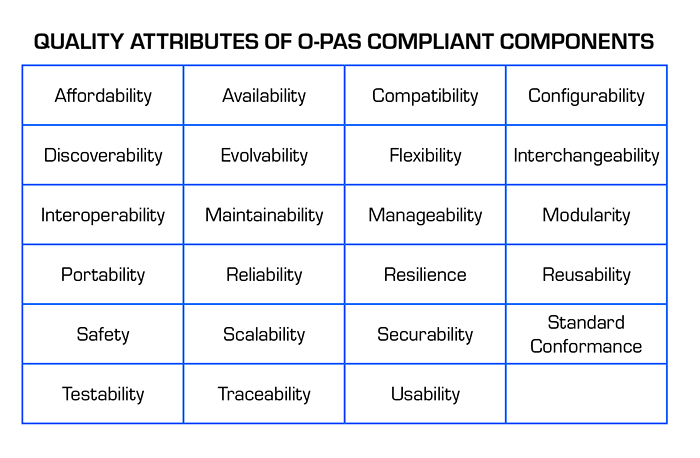
The O-PAS provides the framework for building these interchangeable, portable and modular systems so they can work together and scale as needed. Importantly, this architecture is designed to support updates, enhancements and extensions without requiring a full process shutdown, while also addressing safety, resilience, reliability, maintainability and cybersecurity. Rather than replacing proven industrial practices, O-PAS builds on established standards already used in process automation.
How Does it Work?
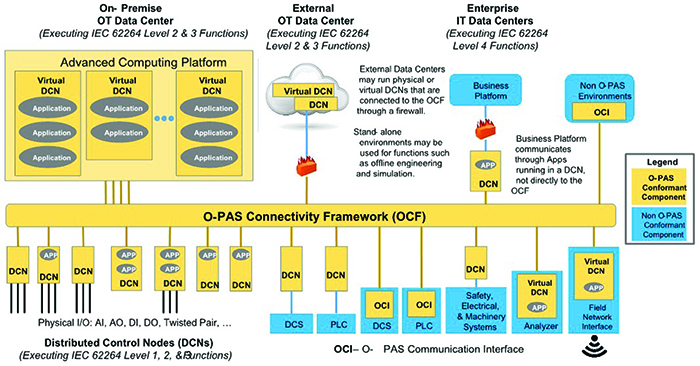
The architecture comprises a collection of connected O-PAS-conformant components, including:
- Distributed Control Nodes (DCNs) – Serve as the primary logic and control processing components within the system.
- O-PAS Connectivity Framework (OCF) – The communications backbone, ensuring logical and deterministic data exchanges between all system endpoints.
- Applications – Comprised of one or more programs, configuration data, and supporting datasets, each handling groups of related automation or control functions.
- Non-conformant Device Gateways – Providing protocol conversion and information mapping for legacy or third-party devices outside the O-PAS standard, preserving interoperability while enabling phased modernization.
- System Execution and Strategy Distribution – These are distributed among the available components, any of which may implement all or part of the required control logic, supporting both centralized and distributed architectures as needed.
What Are the Benefits?
The most immediate benefit of open automation is the freedom to select best-fit components from multiple vendors and upgrade in stages instead of undertaking a disruptive full system replacement.
Interoperability also allows more parts of the plant to share data more effectively, which can improve process visibility, simplify maintenance planning, and support a more coordinated operating model. Over the system lifecycle, cement producers can also benefit from lower costs, easier maintenance and better scalability.
Beyond operational gains, OPA can also remove barriers that have traditionally limited access to AI, machine learning and advanced analytics. By enabling standardized data models and more consistent real-time data flows, it strengthens the plant data foundation needed for better optimization, performance monitoring and decision-making.
Many cement producers think about control system standardization as a choice between vendor X or vendor Y. That is a choice of supplier, not a choice about which standards will drive the most value for the business.
OPA reframes that decision and has proven to have significant financial benefits. A U.S.-based producer of biofuels and food oils found that an OPA-compliant system came in at roughly half the initial hardware and software cost of a traditional DCS, with total cost of ownership more than 25 years running 60-70% lower. If CAPEX approval for control systems projects is a persistent challenge, OPA should be on the roadmap.
Where Are We in 2026?
Open automation still faces practical adoption challenges in 2026. Not every component is equally mature, integration remains complex and migration from legacy systems will take time.
Cybersecurity, conformance and lifecycle management also remain important considerations. At the same time, the ecosystem has moved beyond theory. The Open Process Automation Forum continues to advance the O-PAS architecture and conformance work, and suppliers are bringing more OPA-ready products to market. A high-profile commercial-scale deployment at ExxonMobil’s Baton Rouge resin finishing plant has also helped demonstrate that open, multi-vendor control architectures can operate reliably in production environments.
The cement industry is not starting from zero. Many producers and suppliers have already used hybrid approaches, combining SCADA systems with PAC- or PLC-based platforms to deliver cost-effective and reliable control solutions.
In practice, these architectures have already introduced elements of interoperability and code portability that align with the direction of OPA. For example, a cement plant with two production lines may use different PLC brands on each line, while still presenting operators with a largely consistent control room experience.
These hybrid control systems provide a useful precedent, but proprietary technologies still limit how far this open approach can go. The advantage of O-PAS is that it offers a roadmap for staged adoption rather than a single, high-risk changeover. In fact, many cement plants already use standards that support this direction, including:
- IEC 61131 controller programming standard.
- IEC 62443 cybersecurity standard.
- OPC UA standard communication protocol.
A Case Study – O-PAS in the Cement Industry
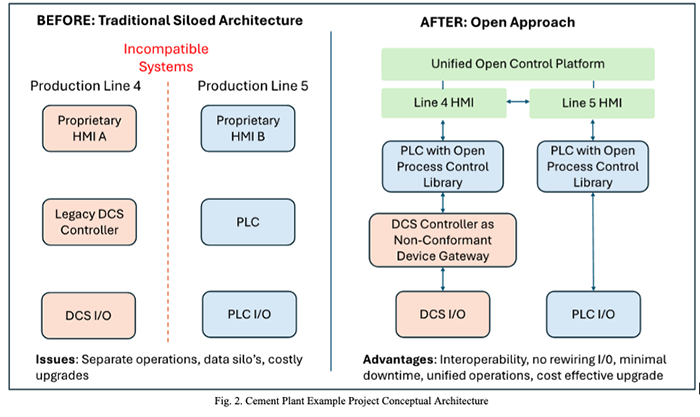
For cement plants, upgrading a control system often means removing legacy I/O and wiring that are still functioning, which can be both costly and operationally disruptive.
A recent cement-sector case study suggests there is a more practical path. The facility was operating two production lines on incompatible control systems: one on a 25-year-old distributed control system and the other on a PLC-based platform. Because the lines had to be managed separately, operators faced avoidable inefficiencies. At the same time, the older line, with approximately 25 000 I/O points, required a major upgrade that would have involved significant downtime.
To meet these needs while protecting production, the plant adopted a solution that retained the legacy I/O and controllers on the older line and the PLCs on the newer line, while unifying the human-machine interface and supervisory logic on a vendor-neutral control platform. The result was a more unified control room environment across both lines, simpler day-to-day operation, and a longer useful life for existing hardware.
This example reinforces a practical point: legacy assets do not automatically prevent progress toward OPA. Existing controllers can serve as gateways, infrastructure can be modernized in stages, and transformation can be aligned with real financial and operational constraints.
Looking to the Future
Open Process Automation offers cement producers a credible path to more flexible, scalable and future-ready control systems — a shift from black boxes to building blocks, and from forced upgrades to planned modernization. The transition does not need to happen all at once.
For plants already working with hybrid architectures, the next step is to identify where open standards and staged modernization can deliver the fastest operational value. Those that start building that roadmap now will be better positioned to reduce lock-in, strengthen their data foundation, and adopt new digital capabilities with less disruption.
David Campain is global product line manager, Process Control Systems, Fuller Technologies, and Trevor Cusworth is vice president of sales and marketing, Collaborative Systems Integration.